

How Much It Costs to Process a Receipt
“Jan, do you have that hotel receipt from last week for me yet?” Receipts, documents, tickets... these are a routine part of business practice, and not just in the workplace. They are also an eternal source of friction with accountants, who are simply trying to do their jobs, keep the books in order, and save us money on taxes. Why do we dislike these and similar questions at work so much?
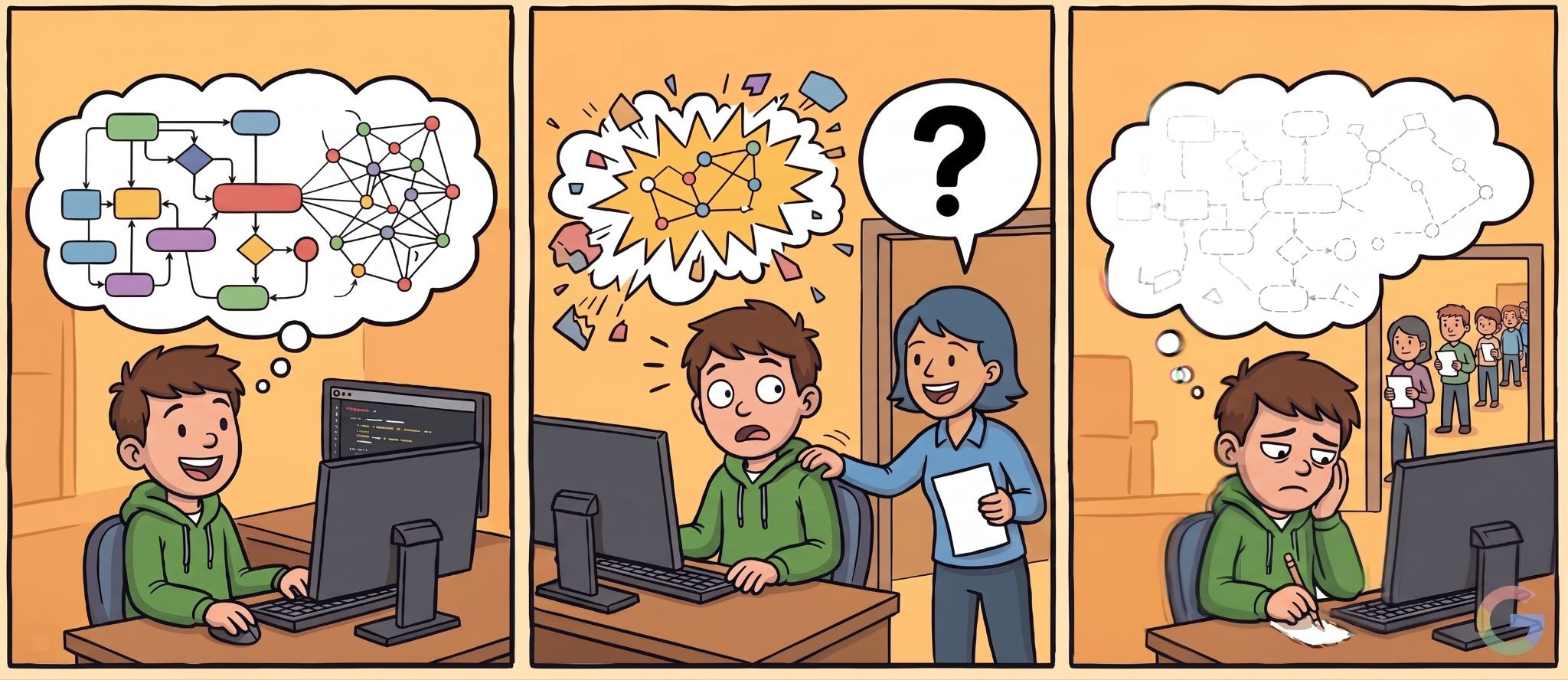
That’s because they represent an interruption, a “context switch,” or a “break in flow.” Your mind stops processing what it was focused on and must dedicate attention to this new stimulus. According to research from the University of California, it takes an average of 23 minutes for the mind to fully recover and refocus on the original problem. This issue has long been recognized, especially among programmers, but with the rise of AI, an increasing number of people are experiencing it firsthand.
You know how it feels when you have to jump between tasks every ten minutes. You try to make up for lost time by working faster, which only leads to more stress, cognitive fatigue, and a higher error rate. This represents a hard-to-measure loss of efficiency and productivity—the so-called switching tax, or “attention tax.”
A Different ROI: Most AI Projects Miss the Mark
A typical AI project today aims to replace a lot of manual labor. Often, thy are successful. However, very few AI projects eliminate that labor entirely. Usually, a portion of it remains—whether it is writing the right prompt, gathering the correct data, validating the outcome, or confirming a decision. While manual labor is saved, the more difficult cognitive work remains.
In practice, this means that instead of focusing on one or two larger tasks, we constantly switch between a multitude of smaller ones, some of which are handled by agents and prompts. On paper, this is clearly more productive (as a portion of the work has disappeared), but in reality, it isn't. It creates a state of perpetual interruption and recalling (“what was I actually doing here?”), validation (“did the AI understand me correctly? Is it hallucinating?”), resting or procrastinating (giving an overburdened brain a chance to breathe - the “AI brain fry”), and work inflation (“since I managed to do X, I'll add Y as well”).
As a result, the expected real ROI simply fails to materialize.
A Case Study from RainFellows: The Receipt Chaser
When our colleague Roman began tackling the issue of chasing down receipts mentioned at the start of this article, his goal wasn't to save the company time or money. He was simply, and justifiably, frustrated by the sheer volume of interruptions at the end of the month when he had to track down missing documents and receipts. His ideal outcome was a solution that would reduce the number of those interruptions.
The resulting Gemini AI solution (which Roman will surely be happy to detail in a separate article) is simply excellent. The AI checks the validity of everything entered as quickly as possible, automatically pairs receipts with past bank payments, independently makes decisions, and operates within defined limits. Therefore, if human intervention is required, it happens immediately (“Jan, you're missing the VAT ID on that receipt!”), or at least relatively soon while it is still fresh in your memory (“Jan, I don't have the receipt for yesterday's payment.”). This helps build good habits and a functional process, because the "punishment" (the interruption) follows shortly after the mistake (the forgotten receipt).
The result? As one of the test subjects, I can confirm a 50% reduction in my own receipt-related errors. The topic of receipts has shifted from "highly annoying" to the much more pleasant realm of "I barely even notice it." That is one less area requiring a mental context switch.
Did the AI replace our accountant? No. That was never the goal. Did it eliminate the tedious part of the work—chasing people down and hunting for documents? Yes. It saved the accountant herself 20% of her time. However, she is still essential; she continues to monitor the system and define additional AI rules. Her primary job now is resolving exceptions and automating other edge cases.
How to Choose an AI Project That Actually Delivers Value
It is certainly still worth looking into areas that involve a lot of tedious, repetitive work—that is where the potential lies. Simultaneously, however, you should focus on areas that cause interruptions or simply annoy you on a human level. There is immense potential there to find a shortcut. Examine a given process and look for solutions that don't just save a fraction of the work, but enable complete delegation and preserve what is truly valuable: your attention.