Change as Everyday Reality
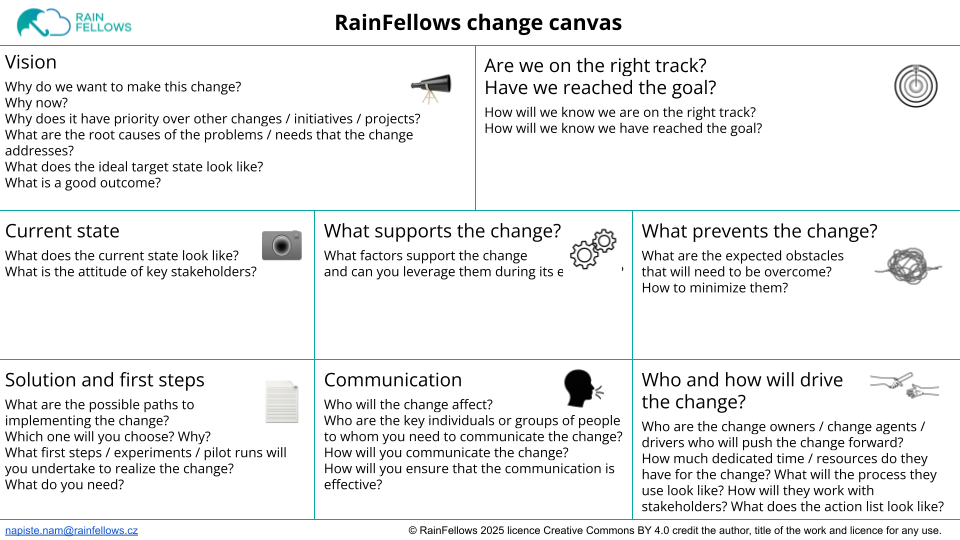
At RainFellows, we encounter change management and transformations daily. Based on this experience, we've created two new workshops focused on managing and adopting change. And to support these workshops, we've developed the RainFellows Change Canvas, which we're making available to you.
Why a Canvas?
A canvas is an excellent tool for working with change because it:
- visualizes the fundamental elements of change in one place
- limited space forces you to select what's essential and be specific
- is co-created with the team and stakeholders, promotes discussion and reveals different perspectives and inconsistencies
Eight Components of the Canvas
1. Vision
A key area including the motivation for change – why we want to implement the change, why act on it right now, as well as answers about the change's priority in the context of other activities, plus what the ideal and good outcome looks like.
2. Are We on Track? Have We Reached Our Goal?
Change needs to be managed. To do this, you need at least basic metrics that will further specify your change goal from the previous canvas area and determine whether you're heading in the right direction. Everything that applies to measuring goals (output vs. outcome, leading metrics vs. lagging metrics, etc. - see article https://www.rainfellows.com/en/blog/post/from-just-outputs-to-real-impact) also applies to the change domain.
3. Current State
Before you start changing anything, you need to know where you're starting from. The current state isn't just a description of problems – it's a comprehensive view of where the organization or team currently is. This area also includes identifying key stakeholders (in the broad sense – this may include people or teams outside your organization) and determining their attitude toward the change.
Understanding the current state will help you set realistic expectations and identify where you'll need the greatest effort.
4. What Supports the Change?
Change isn't just about overcoming obstacles – it's also about leveraging what already works or what can help you.
Factors that support change and you can use during its execution include:
- people who already support the change
- existing processes or tools you can build upon
- external factors (competition, regulation, customer demands) that give the change urgency
- experience from similar changes
- support from leadership or key stakeholders
5. What's Hindering the Change?
What are the expected obstacles that will need to be overcome?
- human factors – fear of change, previous negative experiences with transformations, distrust
- systemic barriers – processes that prevent new ways of working, incompatible tools, poorly set metrics
- cultural aspects – values and beliefs that aren't compatible with the change
These obstacles must be named at the beginning, a strategy found to navigate them, and then actively work with both throughout the entire change.
6. Solutions and First Steps
There are many possible solutions for achieving the target state, and the first idea may not be the best one. Therefore, we recommend building on previous parts of the canvas and brainstorming all possible paths and solutions together with the team managing the change (and possibly with stakeholders). From these, you'll select the most promising one.
In change management, it often pays to think big but start small – with an experiment, pilot project, etc., and then build on its results.
7. Communication
Change never happens in a vacuum. It affects different groups of people in different ways, and if you don't communicate about the change correctly, you're setting yourself up for future problems.
Key communication questions:
- who are the key individuals or groups we need to communicate the change to?
- how will you communicate the change? What format, what frequency?
- how will you ensure the communication is effective?
- how will you convey what this practically means for those affected by the change?
Effective communication isn't about sending emails or presentations at all-hands meetings. It's about creating space for dialogue, answering questions, and working with people's concerns.
8. Who Will Drive the Change and How?
Change won't implement itself. Changes often fail precisely in the execution area, which is why it requires proper attention. Who are the people who will drive the change? How much dedicated time/resources do they have? How will they synchronize? How will they plan, prioritize, and visualize next steps? How will they learn from progress?
How to Work with the Canvas
The canvas isn't a static document to fill out, but a living tool for change management. We recommend using it as follows:
Start with a workshop with the team leading the change. Fill out the canvas together – discuss each section, challenge each other, and seek the best answers. The first version won't be perfect, and that's okay.
Validate it with key stakeholders. Often it's in these discussions that you'll discover the most important insights – for example, that different stakeholders have completely different ideas about the vision or that obstacles exist you didn't know about.
Return to it regularly. Filling out the canvas isn't a one-time activity. You should update it as the change evolves – adding new insights, adjusting plans, changing communication strategy. If your canvas doesn't change over time, something probably isn't going as it should. Change is a dynamic process where you apply gained insights and context changes.
Use it for communication. The canvas is an excellent tool for quickly onboarding new people to the change context or for synchronizing the entire change team.
Conclusion
Change today isn't a choice – it's a necessity. But the way we manage it can determine the success or failure of the entire organization. The RainFellows Change Canvas is our attempt to give leaders and change agents a simple tool to help them navigate the complexity of changes and transformations.
You can download the canvas for free here and start using it under the Creative Commons BY 4.0 license – cite the author, work title, and license for any use.
And if you want to go deeper and learn mastery in implementing changes, check out our workshop "Change? No Problem!" or reach out to us and we'll arrange how to help your people and teams with adopting changes.